Tuesday, July 3, 2012

The Switch in Time that Saved an Illegal Fine


Ongoing allegations that Chief Justice John Roberts based his deciding vote in NFIB v. Sebelius on his vision for the Supreme Court’s political reputation—rather than the Constitution—harkens some historical comparisons. Some commentators approvingly compare the Chief’s savviness of John Marshall; unfortunately, it would appear that Chief Justice Charles Hughes is a more apt comparison.

First, the Marshall comparison. In the landmark 1803 case of Marbury v. Madison, Chief Justice Marshall faced two unsavory alternatives: rule against the hostile President Jefferson and watch the president humiliate the Court by ignoring its ruling, or reluctantly give Jefferson the ruling he wanted. Marshall shocked everyone by ruling in Jefferson's favor, while (of far greater historical significance) announcing that the Court had assumed a brand new power: judicial review, marked by the ability to strike down laws the Court deems unconstitutional. This is now regarded as the judiciary's strongest constitutional power, and Jefferson did not protest it because the Court gave him what he wanted.

Daniel Epps argues in The Atlantic that Roberts demonstrated similar initiative: rather than play into the administration’s ongoing criticisms of the Court’s supposed Republican bias and risk damaging its reputation and influence, Roberts “juked” by giving Obama the ruling he wanted. However, Roberts rejected the administration’s primary contention that the Affordable Care Act comports with the Commerce Clause, and hung his hat instead on the Taxation Clause—thereby arming Republican critics with election year ammunition that Obamacare amounts to a tax increase.

It is a compelling theory…but it ultimately misses the point that Roberts’ switch resulted in a monumental expansion of federal regulatory power. The Court’s opinion that the individual mandate violated the Commerce Clause certainly restores some measure of sanity to that body of law, but the expansion of the Taxation Clause renders the Commerce Clause largely moot. After all, if Congress can simply bypass the Commerce Clause by regulating activity through the guise of taxation, then who needs the Commerce Clause? The Taxation Clause apparently (under this ruling, at least) offers Congress all the legal justification it needs.

Furthermore, it appears that Roberts ruled in large part to pacify an administration that appears intent on bullying the Supreme Court into obedience. After all, President Obama has bullied the Court during press conferences and (infamously) during his State of the Union address. And it seems to have worked.

President Obama has treated the Court with the same hostility as Franklin D. Roosevelt, when the Court overturned parts of his prized New Deal legislation. Roosevelt famously denounced the Court as imposing a “horse-and-buggy” interpretation of the Constitution on the American people. Infamously, Roosevelt threatened to pack the Court with additional justices who would implicitly cast favorable votes. This caused the Court to unexpectedly rule in favor of the New Deal legislation, in what history came to recall as “the switch in time that saved nine.”

However, a closer look at the historical record shows that Congress did not support the court-packing bill and would not have passed it. Moreover, the “switch” caused harm to our Constitution that has still not been repaired to this very day. Therefore, for all intents and purposes, the “switch in time” was an unnecessary measure that caused immeasurable constitutional damage.

Similarly, the Roberts Court faces no clear and present danger of becoming irrelevant. The threat of criticism? Obviously. But newsmakers only criticize relevant institutions, and facing criticism is the price of making difficult decisions about controversial laws.

How ironic is it, then, that the Court now faces an avalanche of criticism? Roberts’ apparent worry of being criticized for playing politics has come true—it just comes from the right, rather than the left. The Chief apparently did play politics, and the American public is calling him on it. Too bad that our Constitution also fell casualty to this game.

Thus, the effects of Roberts' switch in time: (1) growing allegations of the Court's politicization; (2) evidence that the President can bully the Court into obedience; (3) implementation of a wildly unpopular law; and (4) a massive expansion of the Taxation Clause that may haunt American jurisprudence for decades to come.

Along with an illegal fine.

Ryan T. Darby practices civil and public interest law in San Diego.

Friday, December 30, 2011

Verizon Proves That Markets Still Work


Yeah, you'd better hear me now!

Verizon Wireless recently agitated hordes of customers by announcing plans to impose a $2.00 fee for single online or telephone payments.

Well, the thousands of customer complaints Verizon likely received has compelled the company to disconnect this fee plan.

This is an example of free-market capitalism at its finest. A company made a decision its customers didn't like; its customers expressed their outrage; and the company backed off. After all, Verizon bases its business on a series of voluntary transactions with its customers, and since those customers can switch providers with relative ease, Verizon needed to listen to them.

No government strong man was necessary to coerce Verizon's actions; it acted in its own interest, which happens to be satisfying its customers.

The article reporting on this story also reminds us that Bank of America customers pressured it into dropping plans to impose a $5.00 monthly debit card fee.

Long live the markets.

Ryan T. Darby practices law in San Diego. He happens to be an AT&T customer, but he's happy for all his Verizon friends, including his mom.

Thursday, December 22, 2011

Ayres & Edlin Tax Plan Would Drown Everyone on Board

Tax law professors Ian Ayres and Aaron Edlin recently wrote a New York Times op-ed outlining the most disturbing proposal that I've read in a long time: they advocate a 100 percent tax rate on all income that exceeds 36 times the median household income.

In 2006, the median American household income was $50,233. This proposal would therefore cap income for that year at $1,808,388–certainly no small chunk of change. However, the Ayres-Edlin proposal is an absolutely terrible idea that would cost us economic growth, tax revenue, and economic liberty.

First, history teaches us that excessive taxation actually lowers tax revenue. A cursory glance at income tax statistics shows that federal tax revenue was higher in the 1980s than the 1970s. This is interesting because (1) the 1970s was a highly inflationary era, and (2) the Reagan tax cuts slashed the top marginal rate from 70 percent to as low as 28 percent.

Of course, this shouldn't be surprising. Punitive taxation disincentivizes economic productivity; indeed, common sense dictates that people will not work for nothing, as the Ayres-Edlin proposal requires after an individual (or business) earns more than their income limit. Additionally, punitive tax rates incentivize various forms of evasion (some legal, some not). Even if you're a statist, shouldn't you want the rich to earn a whole lot of money that the government can tax? Incentivizing productivity yields higher economic growth and larger tax returns, so everyone wins by allowing "the one percent" to do their damn jobs.

The other problem with the proposal is the arrogance that Ayres and Edlin–or anyone else–has either the clairvoyance or the moral imperative to dictate how much money is too much for one person to earn. Wealth accrues in a market economy through a multitude of individual, voluntary transactions. To chide someone for being too successful strikes me as jealousy wrapped in an egalitarian facade.

I can't conclude without pointing out the absurdity of their statement that "The sky is the limit for the rich as long as the 'rising tide lifts all boats.'" Ayres and Edlin, of course, are borrowing President Kennedy's justification for slashing the top marginal rates. President Kennedy knew that everyone would benefit by allowing the rich to keep–and invest–more of their income. Perhaps, then, a more appropriate metaphor for Ayres and Edlin is that a sinking ship drowns everyone on board.

Tuesday, November 15, 2011

Occupy Wall Street: Rebels without a Case

A New York judge upheld the constitutionality of Mayor Bloomberg's decision to prevent Occupy Wall Street protestors from sleeping in the Zuccotti Park.

And frankly, it wasn't even a close call.

The Supreme Court has made it quite clear that laws prohibiting sleeping in public spaces apply just as equally to protestors as they do to everyone else. In Clark v. Community for Creative Non-Violence, the Court held that the National Park Service could enforce such a law against homeless advocates who wished to sleep on the Washington Mall.

Specifically: "Damage to the parks, as well as their partial inaccessibility to other members of the public, can as easily result from camping by demonstrators as by nondemonstrators. In neither case must the government tolerate it." The Court resolved that this ruling is "a reaffirmation that reasonable time, place, or manner restrictions on expression are constitutionally acceptable."

The Court's rationale is very simple: protestors have to follow the same rules as everybody else. In this case, Occupy protestors have no more of a right to create a public health hazard than those who are legitimately homeless. Furthermore, Occupy Wall Street's argument is even weaker because Zuccotti Park is not public property; it is privately owned, and its owners wanted the protestors off their property.

The Occupy protests are a terrific distraction from the drudgeries of actually working for a living, but they don't have a legal leg to stand on.

Tuesday, October 11, 2011

Dear "Rich Kid for Redistribution": Just shut up & give it away.

This girl epitomizes the problem with so many wealthy statists (and those who pretend to be, as I'm guessing is the case here).

She purportedly deplores the fact that she has money, and she chooses to do...well, nothing about it. If she really wants her money to go to the less fortunate, then why doesn't she just give it away? There are plenty of worthy charities out there that are far more efficient than the government.

Alas, I suspect she prefers to use her money as a status symbol, just like the people she's protesting. "Look at me! I have money that I don't need, so I want to help the less fortunate! Look at what a wonderful person I am!"

Oh, just shut up and give it away, already.

Thursday, September 15, 2011

...and she wants to control MORE of our tax dollars?

Oops.
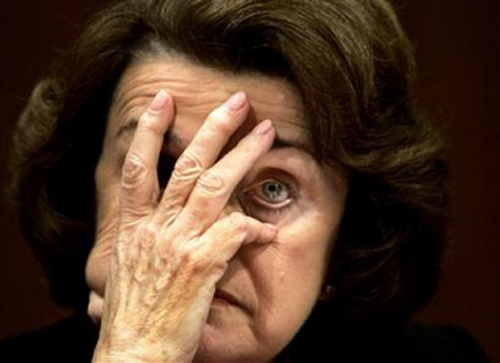
Sen. Dianne Feinstein (D-CA) announced that her campaign war chest was "wiped out" by treasurer Kinde Durkee. Ms. Durkee faces federal charges for allegedly plundering hundreds of thousands—if not millions—of dollars from Democratic candidates throughout California.

Oddly enough, Sen. Feinstein does not know how much money Ms. Durkee stole from her. Why not? Because, according to Politico.com:
Feinstein said she and her campaign staff have been unable to access all their bank records at this point because Durkee alone controlled access to the account, which has made it difficult for them to assess how much money is gone.
Seriously? What kind of fool provides a third party with sole, unchecked access to a financial account?

Oh, wait—the same fools responsible for America's $14.7 trillion national debt.

And if Sen. Feinstein is this irresponsible with her own campaign's money, then what makes us think she is responsible with ours? 

Ryan T. Darby practices law in San Diego. He has yet to find himself locked out of any of his bank accounts.

Thursday, August 18, 2011

Law School Blame Game Heads East

I previously blogged about an unemployed lawyer's regrettable lawsuit against Thomas Jefferson School of Law. The angry alumnus alleged that the law school misled her into believing her odds of post-graduate employment were stronger than they actually were, even though a simple glance at the school's bar passage rates should have easily dispelled her purported misconception.

Well, it looks like the Law School Blame Game is hitting the road, as alumni from New York Law School and Cooley Law School have filed similar complaints against their respective alma maters. Cooley, meanwhile, appears to be striking back by filing a defamation action against Kurzon Strauss, the law firm representing the unemployed alums.

The story is pretty simple at the end of the day: the plaintiffs applied to law school without performing their due diligence, graduated in the middle of a bad economy, want to blame someone, and decided their law schools are easy (and wealthy) enough targets. Bad times often popularize bad ideas, so I really hope for the sake of the legal profession that this one doesn't catch on.

Ryan T. Darby practices law in San Diego, California. He received an outstanding legal education and has no plans of suing his alma mater.